
PROFESSIONAL OUTDOOR PORCELAIN TILE AND PATIO CLEANING
Mobile: 07546 947214
Email: thejetwashfella@outlook.com
Porcelain paving has become increasingly popular for modern gardens, patios, pathways and outdoor entertaining areas.
It looks fantastic when it is clean, but outdoor porcelain is not maintenance-free. Over time, algae, moss, black spot lichen, dirt, leaf staining and general weathering can build up across the surface.
The result can be a patio that looks dull, dirty and sometimes slippery when wet.
At The Jet Wash Fella, we provide professional porcelain tile and patio cleaning across Sussex and Surrey, using appropriate cleaning treatments and carefully controlled pressure to remove built-up contamination while taking care around the tiles, joints and surrounding areas.
With around 20 years of hands-on pressure washing and exterior cleaning experience, we understand that porcelain needs a different approach from natural sandstone, concrete and block paving.
The aim isn’t simply to blast the dirt away. It’s to clean the porcelain properly while taking care of the surface and surrounding installation.
Why Do Outdoor Porcelain Tiles Get Dirty?
Porcelain is manufactured to have very low water absorption, making it an excellent choice for outdoor paving. However, outdoor conditions can still result in contamination building up on the surface.
Textured and slip-resistant porcelain finishes can contain tiny grooves and surface patterns where dirt and organic growth can accumulate.
Common problems include:
- Green algae
- Moss
- Black spot lichen
- General dirt and grime
- Mud and soil
- Leaf staining
- Bird deposits
- BBQ grease and food spills
- Water marks
- Weather staining
- Residue from previous cleaning
- Cement or grout haze following installation
Patios surrounded by trees, gardens with shaded areas and surfaces that remain damp for long periods can be particularly susceptible to algae and organic growth.
Porcelain Cleaning Is Different From Cleaning Sandstone
Although porcelain is a durable paving material, it should not simply be treated in exactly the same way as every other outdoor surface.
Natural sandstone is porous and relatively soft, whereas porcelain is a manufactured, vitrified paving product with very low water absorption.
However, porcelain patios can still have vulnerable areas, particularly around:
- Grout and pointing
- Brush-in jointing compounds
- Tile edges
- Corners
- Steps
- Drainage points
- Surrounding landscaping
Using excessive pressure in the wrong place can disturb jointing or create unnecessary splash-back and mess.
The correct pressure, equipment, nozzle and cleaning treatment all have a part to play.
Our Porcelain Tile Cleaning Process
Initial Assessment
Before cleaning begins, we look at the porcelain and the surrounding installation.
We consider the type and finish of the tiles, the amount of contamination, the condition of the joints and whether there are any existing problems that need to be taken into account.
Clearing Loose Dirt & Debris
Leaves, loose moss, soil and other surface debris are removed before the main cleaning process begins.
This allows the cleaning treatment and pressure cleaning to work more effectively.
Applying a Suitable Cleaning Treatment
Where algae, moss, lichen and other organic contamination are present, an appropriate treatment can be applied before the main clean.
This helps break down the contamination rather than relying entirely on mechanical pressure.
Controlled Low-Pressure Cleaning
Once the surface has been suitably treated, the porcelain is carefully cleaned using controlled, low-pressure cleaning where appropriate.
The pressure and cleaning method are selected according to the condition and type of porcelain.
The objective is to remove the contamination without unnecessarily disturbing the tiles or surrounding joints.
Detailing Edges & Difficult Areas
Edges, corners and areas around walls, doors and garden features can collect more dirt than the main surface.
These areas are given additional attention where required.
Final Rinse & Inspection
After cleaning, the area is thoroughly rinsed and inspected.
We also check surrounding areas for displaced dirt and residue before completing the job.
Removing Black Spots From Porcelain
Black spotting is one of the most noticeable problems that can develop on lighter porcelain paving.
Those small dark marks can be extremely stubborn and are often associated with lichen and other organic contamination becoming established within the texture of exterior paving.
Simply pressure washing the surface may improve the appearance without completely removing every mark.
Our approach combines appropriate treatment with controlled cleaning, allowing the treatment to help break down the contamination before it is washed away.
Can Every Black Spot Be Removed?
Not necessarily.
Some black spotting can become very well established, and the result depends on the age, condition, surface texture and type of contamination.
We prefer to be honest about what can realistically be achieved rather than promise that every individual mark will disappear.
Cleaning New Porcelain Patios After Installation
New porcelain patios can sometimes have a completely different cleaning problem.
Instead of algae and weathering, the surface may be affected by cement haze, grout residue or installation film left behind during laying.
This can leave beautiful new porcelain looking cloudy or dull.
Simply pressure washing the patio may not resolve this type of contamination.
The appropriate cleaning treatment needs to be selected according to the type of residue and, where appropriate, the manufacturer’s recommendations.
New porcelain should be treated carefully, particularly where fresh jointing or grout is present.
Porcelain Patio Cleaning After Winter
Winter can be particularly hard on outdoor patios.
Rain, damp conditions, fallen leaves and reduced sunlight can create ideal conditions for algae and organic growth.
By spring, a porcelain patio that looked fantastic during the summer can be covered in:
- Green algae
- Dirt
- Moss
- Black spotting
- Leaf staining
- General winter grime
A professional spring clean can make a significant difference to the appearance of your outdoor space.
Can Porcelain Patios Become Slippery?
Yes.
Although many porcelain paving products are manufactured with slip-resistant characteristics, contamination sitting on top of the paving can affect how the surface feels underfoot.
Algae, moss, dirt and other organic growth can contribute to a slippery surface, particularly when the patio is wet.
Cleaning away this contamination can help restore the appearance and intended surface characteristics of the paving.
This can be particularly important around:
- Garden paths
- Steps
- Swimming pools
- Hot tubs
- Outdoor seating areas
- Frequently used walkways
Porcelain Pool Surround Cleaning
Porcelain is increasingly popular around swimming pools because of its modern appearance and practical properties.
Pool surrounds require additional care during cleaning because of their proximity to the pool, drainage systems, surrounding landscaping and other surfaces.
We can assess and clean suitable porcelain around:
- Swimming pools
- Hot tubs
- Outdoor showers
- Pool houses
- Leisure areas
Our cleaning approach takes the surrounding environment into consideration rather than treating the pool surround as an isolated surface.
Porcelain Garden Path & Walkway Cleaning
Porcelain pathways can develop algae and grime just as quickly as patios.
This is particularly common where paths are shaded by:
- Trees
- Fences
- Buildings
- Walls
- Garden planting
Cleaning a pathway can make a surprisingly large difference to the overall appearance of a garden.
We can assess and clean suitable porcelain:
- Garden paths
- Steps
- Courtyards
- Terraces
- Side passages
- Outdoor seating areas
- Pool surrounds
BBQ Grease, Food & Everyday Stains
Outdoor porcelain patios are often used as an extension of the home during the warmer months.
BBQs, outdoor dining and entertaining can leave behind stubborn marks.
Depending on the type of stain, we can assess areas affected by:
- BBQ grease
- Food spills
- Drink stains
- Leaf tannins
- General dirt
- Bird deposits
- Mud and soil
Different stains can require different cleaning approaches, so the treatment used will depend on the particular problem.
Do Porcelain Tiles Need to Be Sealed?
Generally, porcelain paving does not need sealing in the same way that porous natural stone may do.
Porcelain has very low water absorption, meaning a conventional penetrating sealer is usually unnecessary.
However, there are many different porcelain paving products and finishes available, so manufacturer’s guidance should always be considered.
If someone recommends sealing your porcelain after cleaning, it is worth finding out exactly what the product is designed to achieve and whether it is suitable for your particular tiles.
We Don’t Treat Every Patio the Same
This is an important part of professional exterior cleaning.
A sandstone patio, block-paved driveway, concrete surface and porcelain terrace are all different materials.
They can require different:
- Pressure levels
- Cleaning techniques
- Treatments
- Equipment
- Finishing methods
The Jet Wash Fella doesn’t believe in one pressure setting or one cleaning method for everything.
We assess the surface and adapt our approach according to what we find.
Porcelain Tile Cleaning for Homes & Commercial Properties
Our porcelain cleaning service isn’t limited to domestic patios.
We can also assess larger porcelain areas at:
- Restaurants
- Hotels
- Holiday properties
- Commercial premises
- Communal developments
- Outdoor seating areas
- Leisure facilities
- Pool areas
Larger commercial projects may require additional planning around access, water supply, pedestrians, drainage and suitable working hours.
Porcelain Tile Cleaning Across Sussex & Surrey
Based in Crawley, West Sussex, The Jet Wash Fella provides exterior porcelain cleaning across Sussex, Surrey and surrounding areas.
West Sussex
We cover Crawley, Horsham, Billingshurst, East Grinstead, Haywards Heath, Burgess Hill, Worthing, Pulborough, Chichester and surrounding towns and villages.
Surrey
We cover Guildford, Woking, Reigate, Redhill, Dorking, Horley, Godalming, Cranleigh, Epsom, Leatherhead, Farnham, Camberley and surrounding areas.
We also undertake selected work towards South London and surrounding areas.
If you’re unsure whether we cover your location, simply get in touch.
Why Choose The Jet Wash Fella?
Around 20 Years of Hands-On Experience
With around 20 years working within pressure washing and exterior cleaning, we have experience working with a wide range of external surfaces.
That experience helps us understand that different materials require different cleaning methods.
Specialist Surface Knowledge
Porcelain isn’t cleaned in exactly the same way as sandstone, block paving or concrete.
We consider the type of surface, level of contamination and condition of the installation before choosing the appropriate approach.
Careful Pressure Control
More pressure doesn’t automatically mean a better clean.
The right pressure is the pressure that removes the contamination effectively without unnecessarily attacking the surface or joints.
Honest Advice
If we don’t believe a particular cleaning method is suitable for your patio, we’ll tell you.
We’d rather provide honest advice than promise something simply to secure the work.
Domestic & Commercial Cleaning
From a small garden patio to larger commercial outdoor areas, we can assess the job and recommend a suitable cleaning approach.
Before & After Porcelain Cleaning
A good before-and-after photograph can show just how much contamination porcelain paving can collect.
Once algae, grime, staining and organic growth have been removed, the original colour and pattern of the paving can become visible again.
The difference can be remarkable.
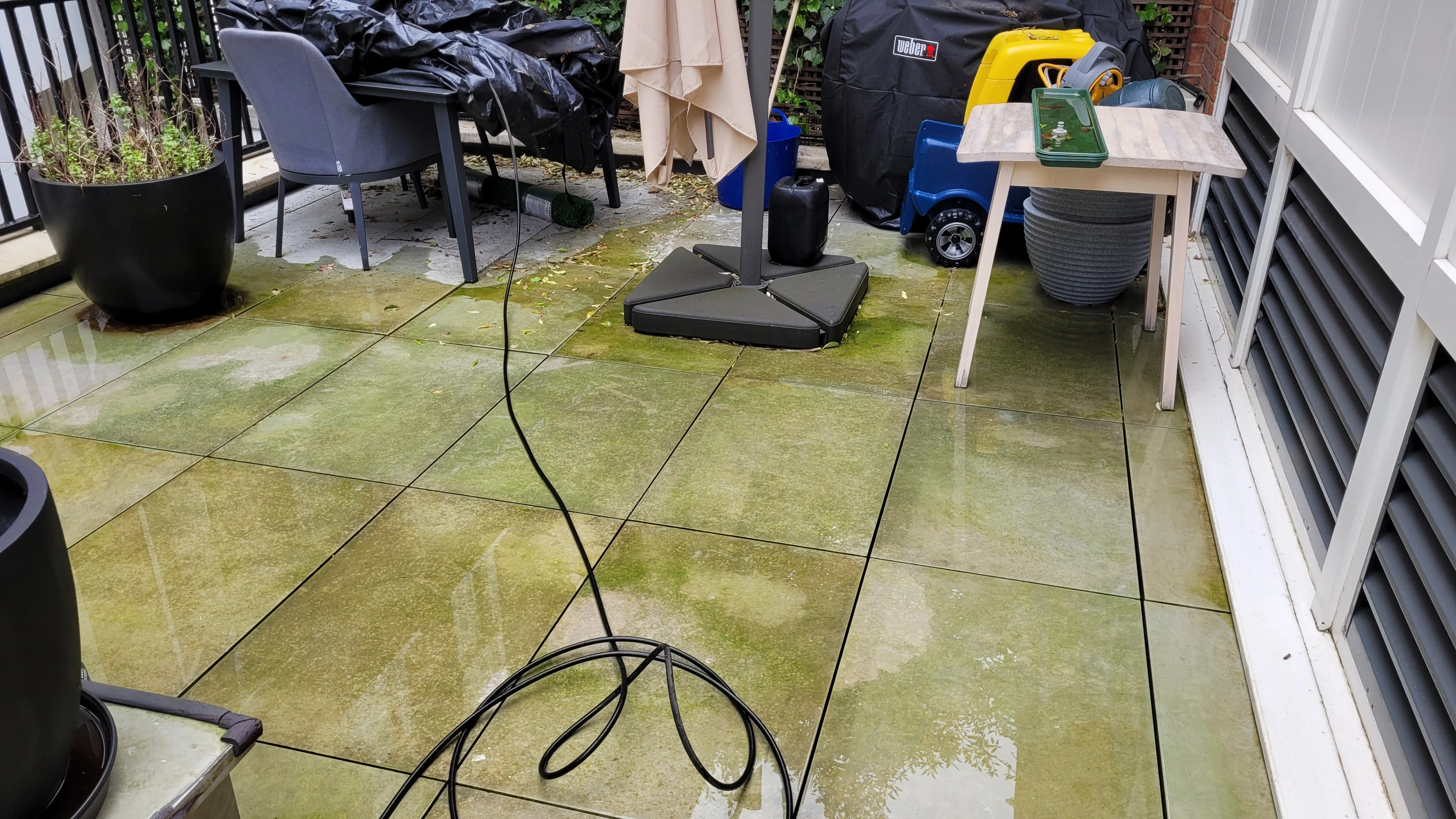
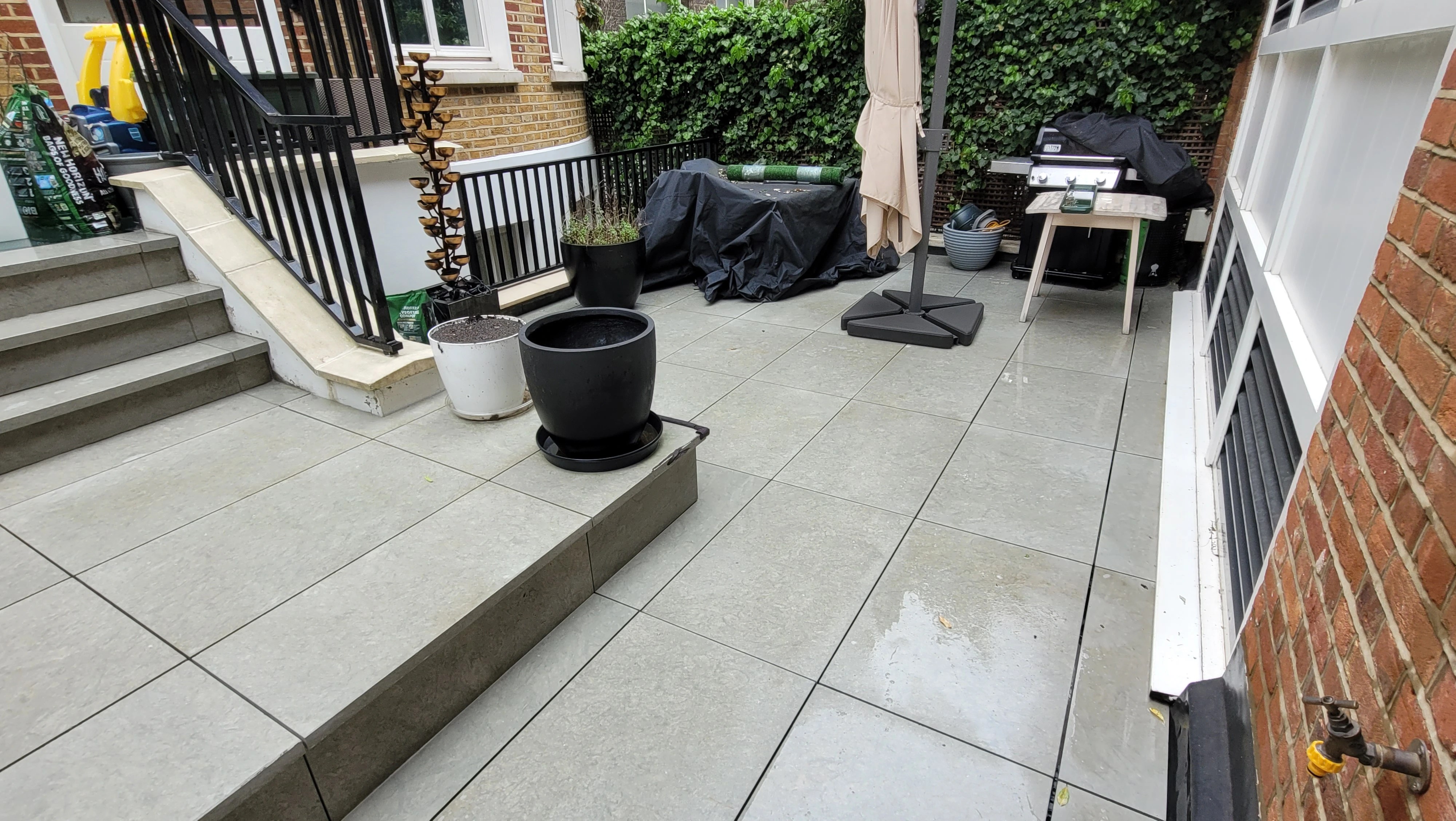
Porcelain Patio Before & After
This before-and-after comparison shows a porcelain patio that had become heavily covered in algae.
The patio was carefully cleaned using a low-pressure cleaning approach, helping to remove the algae and reveal the clean porcelain surface underneath.
Frequently Asked Questions About Porcelain Tile Cleaning
1. Can Porcelain Patios Be Pressure Washed?
Yes, but the pressure and cleaning method should be appropriate for the particular porcelain and its installation.
Excessive pressure can potentially disturb joints or cause problems around vulnerable areas, which is why we assess the surface before cleaning.
2. Can You Remove Black Spots From Porcelain?
We can treat and clean black spotting associated with organic contamination such as lichen.
Heavily established marks may require additional treatment, and results can vary depending on the condition and texture of the tiles.
3. Can You Clean Slippery Porcelain Patios?
Yes. We can remove algae, moss, grime and other contamination that can contribute to a slippery surface, particularly when the patio is wet.
4. Can You Clean New Porcelain With Cement Haze?
Yes, we can assess porcelain affected by installation residue, cement haze or grout contamination.
The appropriate treatment depends on the type of residue and condition of the installation.
5. Will Cleaning Damage My Porcelain?
Our aim is to clean the surface using an appropriate method while taking care around the tiles, joints and surrounding areas.
We assess the porcelain before choosing the cleaning approach rather than automatically using maximum pressure.
6. Can You Clean Porcelain Around a Swimming Pool?
Yes. We can assess suitable porcelain pool surrounds and take additional care when working around pools, drainage and surrounding landscaping.
7. Do Porcelain Patios Need Sealing?
Usually, porcelain does not require sealing because of its very low water absorption.
However, individual products and finishes vary, so manufacturer guidance should always be considered.
8. How Often Should Porcelain Paving Be Cleaned?
There is no universal cleaning schedule.
A patio surrounded by trees and shade may need cleaning more frequently than a sunny, open patio.
Regular sweeping and removing leaves can also help reduce the amount of contamination that builds up.
9. Can You Clean Porcelain Paths and Steps?
Yes. We can assess porcelain paths, steps, courtyards and other outdoor tiled areas as well as patios.
10. How Long Does Porcelain Patio Cleaning Take?
This depends on the size of the area, access, condition of the tiles and amount of contamination.
We can give you a better indication after assessing the patio.
11. Do You Clean Commercial Porcelain Areas?
Yes. We can assess larger commercial patios, terraces, outdoor seating areas, leisure areas and other suitable porcelain installations.
12. How Do I Get a Quote?
You can contact Matthew on 07546 947214 or send photographs of your porcelain patio for an initial assessment.
Get Your Porcelain Patio Cleaned
If your porcelain patio has become green, dirty, stained or slippery, don’t assume that the paving itself has permanently changed colour.
A professional clean can make a remarkable difference to the appearance of outdoor porcelain.
The Jet Wash Fella provides porcelain tile and patio cleaning across Sussex and Surrey, using appropriate treatments and controlled cleaning techniques to restore the appearance of outdoor porcelain.
Call or WhatsApp Matthew: 07546 947214
Email: TheJetWashFella@outlook.com
Website: thejetwashfella.uk
Where we cover
Copthorne, Crawley,
Horsham, East Grinstead, Reigate, Redhill, and beyond.
Follow us
Facebook
Twitter
Instagram

This website was created by Design SEO Website.

